

Authors: Maame Akua Amoah Twum and Baboucarr Fatty
Site of publication: afrobarometer.org
Type of publication: Report
Date of publication: July 2023
Police/Security presence
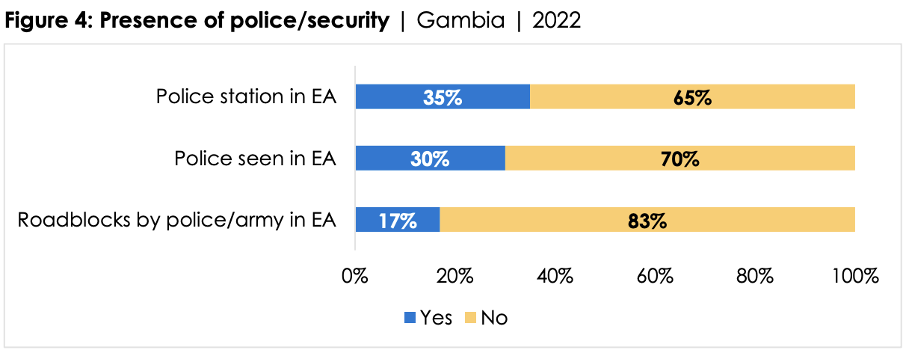
The presence or absence of security forces may have an effect on people’s sense of security. As part of their data-collection process, Afrobarometer field teams make on-the-ground observations in each census enumeration area (EA) they visit about services and facilities that are available in the area. Since the EAs visited are selected to represent the population of the country as a whole, these data provide reliable indicators of infrastructure and service availability. In the Gambia, Afrobarometer field teams found police stations in or within easy walking distance of about one-third (35%) of the EAs they visited (Figure 4). They saw police officers or police vehicles in 30% of the EAs, and police or army roadblocks in 17% of them. Other signs of security-related activity were less common, including presence of soldiers or other military personnel (15%), roadblocks by private security or the local community (7%), and customs checkpoints (4%).
The share of citizens who felt unsafe or feared crime does not vary greatly based on whether they have a police station in the area.
Encounters with the police
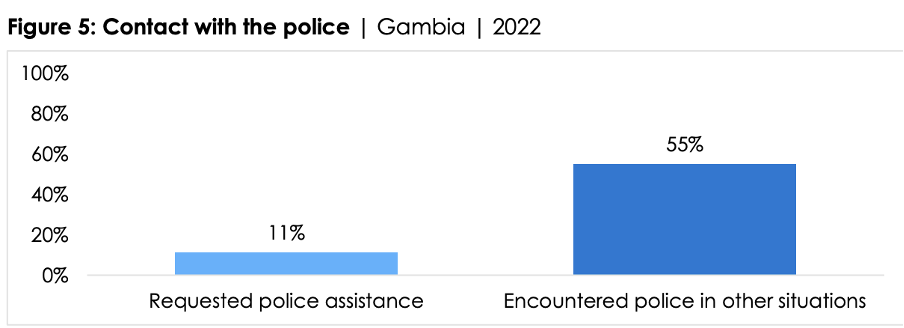
How often do Gambians encounter the police in their daily lives? About one in nine respondents (11%) say they requested police assistance during the previous year. Five times as many (55%) encountered the police once or more in other situations, such as at checkpoints, during identity checks or traffic stops, or during an investigation (Figure 5). About one in 12 citizens (8%) report police contact of both types during the previous year, i.e. requesting police assistance and in other, less voluntary, encounters, while 41% say they did not interact with the police.
Police corruption
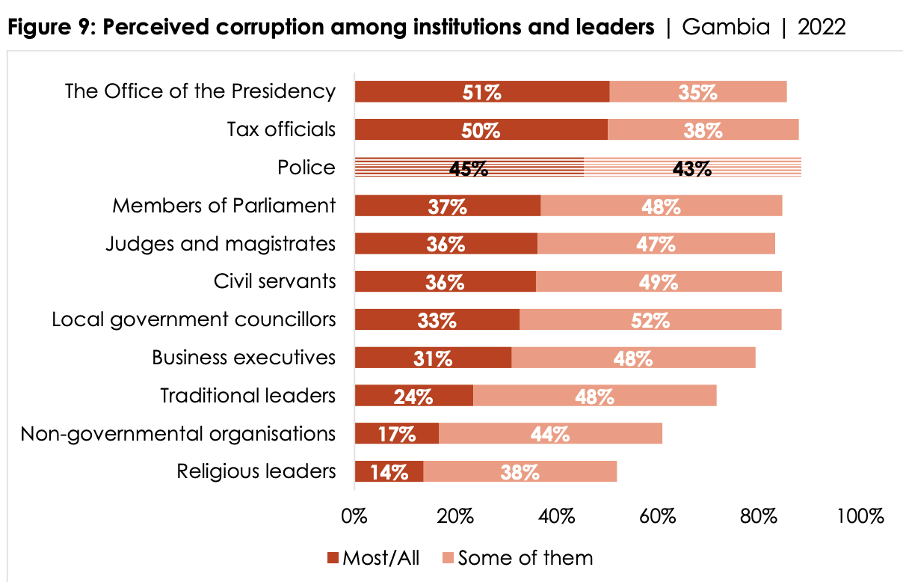
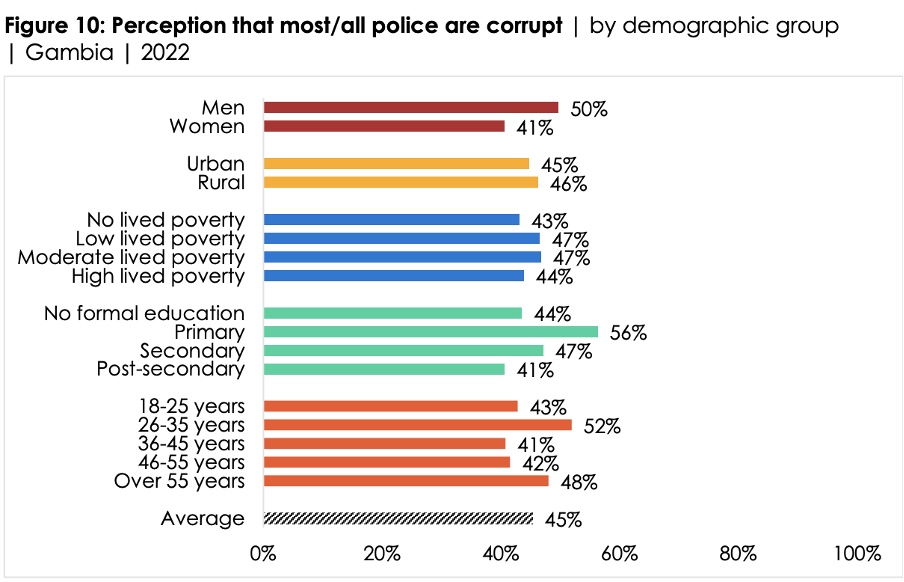
Almost half (45%) of Gambians say that “most” or “all” police are corrupt – the third-worst rating among 11 key institutions and leaders the survey asked about (Figure 9), and 7 percentage points higher than in 2018 (38%). In addition, 43% of respondents say “some” police officials are corrupt. Men are more likely than women to say that most/all police are corrupt (50% vs. 41%). Citizens with post-secondary education are less likely to share this view (41%) than those with less schooling (44%-56%) (Figure 10).
Trust in the police
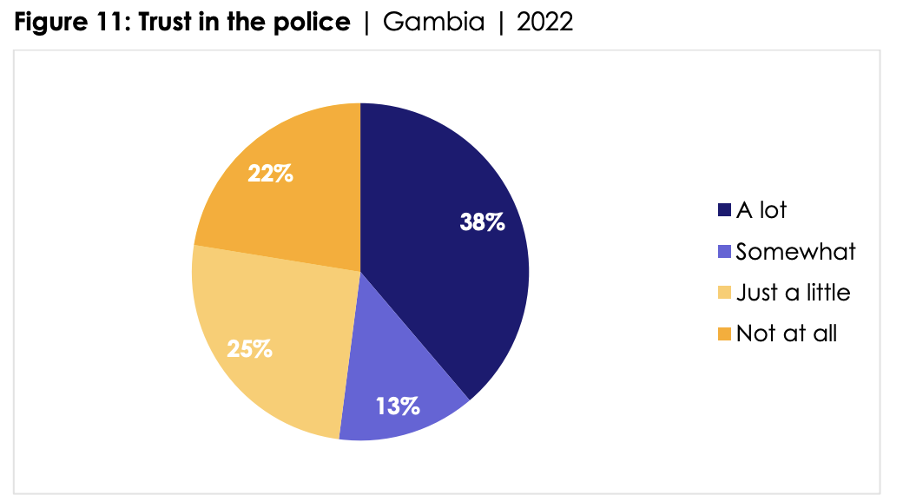
Do Gambians trust the police? More than half (52%) say they trust the police “somewhat” (13%) or “a lot” (38%) (Figure 11), a 7-percentage-point decrease compared to 2021 (59%). Almost half (47%) express little or no trust in the police.
Police conduct
In addition to significant mistrust in the police, many Gambians say at least some police officers engage in improper and even illegal activities. Four in 10 citizens (41%) say the police “often” or “always” stop drivers without good reason, in addition to 37% who say they “sometimes” do this.
Conclusion
Survey findings show that growing numbers of Gambians feel unsafe in their neighbourhoods and homes and think the government is doing a poor job of fighting crime. Public perceptions of the police are decidedly mixed, with significant proportions – though still minorities – reporting that assistance is difficult to obtain and that bribes must be paid to get help or avoid problems. Many citizens also say that police officers use excessive force with protesters and suspected criminals, stop drivers without good reason, and engage in illegal activities. Overall, fewer than one-third of Gambians say the police usually operate in a professional manner and respect all citizens’ rights – a clear call to action for a government seeking to build a professional force.