
Katharina Meyer zu Tittingdorf
The digital sphere has emerged as a central arena of power, connecting nearly everyone, everywhere, at any time. A world without the internet is almost unimaginable today, since it structures both private and public life and increasingly blurs the boundary between the two. Internet access is even discussed as human right, as it is tied to rights such as freedom of expression, access to information, and economic participation. Yet the same digital environment that enables empowerment also creates new vulnerabilities. Disinformation, online surveillance, and cyber security have grown into global concerns.
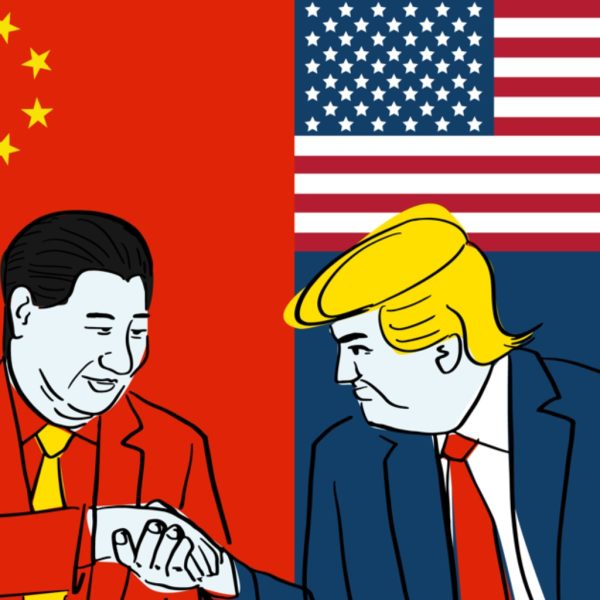
As governments increasingly recognize the strategic importance of this domain, they view the digital sphere not only as a technological tool but as a political and economic asset to be shaped, regulated and controlled. This struggle for influence is most visible in the rivalry between the United States and China.
Caught in the Thucydides Trap? How China’s Tech Rise Challenges U.S. Power and Competing Models of Digital Governance
For decades, U.S.-based technology firms have dominated global digital markets outside China. Each of the U.S.-based five tech giants Google (Alphabet), Amazon, Meta, Apple, and Microsoft holds a significant position in different digital markets across sectors ranging from online search and social media to cloud computing, e-commerce and mobile operating systems. Combined, they generated more than 1.5 trillion U.S. dollars in revenue in 2024. Their power is based on the collection and processing of personal data, used to optimize targeted advertising systems and train generative artificial intelligence systems.
Social media platforms illustrate this influence most clearly. With more than five billion users worldwide in 2024, Social Media Platforms have enormous power, as they shape what millions of people see and, for many, serve as the primary gateways to news and public discourse. The U.S. firm Meta dominates the market with its platforms Facebook, Instagram and WhatsApp. Facebook alone has approximately 2.9. billion monthly users. Amnesty International has repeatedly highlighted that the intrusive data collection and algorithmic systems of major social media companies violate private rights and amplify harmful content, as such content tends to generate stronger reaction from users and keeps them online longer. Such dynamics can have severe consequences. In northern Ethiopa, for example, Facebook posts inciting violence against the Tigrayan community spread widely, contributing to severe human right abuses.
Social media has become a key arena for political competition over influence on public discourses. U.S. President Donald Trump in particular uses social media to spread controversial content and misinformation. False claims about the 2020 presidential election led to the temporary suspension of his accounts on major platforms such as X (formerly Twitter), Facebook, and Youtube. In response, Trump launched his own social media platform “Truth Social” in 2022 which shows the struggle over the authority of truth in digital spaces. Beyond national politics, social media has become a global battleground, as China have been accused of online (dis)information campaigns to sabotage and discredit the U.S. democratic system and influencing the presidential campaigns.
Over the past two decades, China has emerged as a strong rival to U.S. technological leadership. China’s economy has grown in a few decades in an extremely fast pace and has now the world’s most important high-tech sector and the world’s largest manufacturing and internet sectors. By the 2010s, Chinese firms such as Huawei and ZTE had established themselves as major global players in the telecommunication infrastructure market, and today companies such as Xiaomi dominate the global mobile handset markets. As of February 2025, TikTok had approximately 1.99 billion monthly users worldwide, while WeChat reached around 1.41 billion, placing both platforms just behind Meta’s social media platforms and YouTube in global rankings.
Chinas digital governance model, however, differs sharply from that of the United States. While the U.S. traditionally promotes a neoliberal ideal of an open, innovation-driven internet ecosystem without restrictions and a free flow of data, China embraces the principle a cyber sovereignty which underlines the leading role of the state in cyber governance. Its Golden Shield Project, commonly known as the Great Firewall of China, implements a politic of censorship and surveillance. Beyond restricting content related for example to political protests and censorship, it blocks major global platforms such as Google, Facebook, YouTube and X to foster digital self-reliance and domestic tech industries.
While trade competition between the United States and China has a longer history, the digital trade war escalated significantly after 2018 under the Trump administration and reflects a broader global shift toward sovereignty-based approaches to digital governance. The dispute centers on control over key technologies such as semiconductor, 5G networks, artificial intelligence, making the U.S.–China tech rivalry a key dimension of their broader geopolitical confrontation.
Over the past two decades, China has emerged as a strong rival to U.S. technological leadership. China’s economy has grown in a few decades in an extremely fast pace and has now the world’s most important high-tech sector and the world’s largest manufacturing and internet sectors. By the 2010s, Chinese firms such as Huawei and ZTE had established themselves as major global players in the telecommunication infrastructure market, and today companies such as Xiaomi dominate the global mobile handset markets
The U.S. frames China as a threat to digital freedom and the national security. Concerns in Washington have been fueled by cases of espionage and cyberattacks, as well as by the close relationship between the Chinese Communist Party and domestic technology firms. Although Chinese companies claim independence from the state, Chinese law could compel the companies to cooperate with the government for national security issues and to support the national intelligence efforts, raising questions about the safety of data handled by Chinese technology providers.
Central to the US-China rivalry are Semiconductor Supply Chain Disruptions. The US leverages its dominance in the high-end segment of the semiconductor supply chain through leading firms such as Intel, NVIDIA and Qualcomm to impose export controls on advanced chips to China. These measures aim to restrict China’s access to critical equipment for next-generation production and to limit its ability to develop advanced artificial intelligence and military capabilities. One of the most affected companies is Huawei, China’s leading telecom company. Since 2018, the U.S. government under Donald Trump and continued by the Biden administration has gradually banned the Huawei from its 5G networks and has urged allied countries to adopt similar restrictions. Washington argues that China’s dominance in 5G infrastructure could enable espionage and the control of global communications. Despite these sanctions, Huawei remains the world’s largest telecom equipment manufacturer, holding a 34 percent global market share in 2024, an increase of two percentage points since 2018 largely due to extensive state support. In response to U.S. restrictions, Huawei has accelerated efforts to reduce its dependence on foreign technology by developing its own operating system, designing domestic chips and sourcing components from alternative suppliers. During the time U.S. firms lost sales of over 33 billion dollars to Huawei between 2021 and 2024, highlighting the economic trade-offs of restrictive export policies. Recently, signs of a shift in US’ tech export policy have emerged. On December 8 2025, President Trump announced that NVIDIA would again be permitted to sell AI chips to China. Although it remains unclear whether China will respond with reciprocal policy changes.
To date, China has responded to the US-sanctions with “mirror measures” including restrictions on U.S. Micron products, justified by similar references to national security concerns. Additional measures include the induction of domestic chip consumers to exclude U.S. chips and chip designs, as well as imposing export restrictions on critical materials such as gallium and germanium. At the same time, the Chinese government has significantly increased investments to support domestic companies and innovation and encouraged companies to focus on higher-node chips essential for industries such as electric vehicles. In parallel, some firms have found ways to circumvent export restrictions.
Central to the US-China rivalry are Semiconductor Supply Chain Disruptions. The US leverages its dominance in the high-end segment of the semiconductor supply chain through leading firms such as Intel, NVIDIA and Qualcomm to impose export controls on advanced chips to China
The US-China tech rivalry pushed both countries toward technological decoupling, aiming to reduce dependence on each other’s technology and secure their own technological sovereignty. The rivalry affects not only the economic sector but also determines the handling of personal data and digital access, as seen in the threatened TikTok ban, potentially limiting free access for U.S. citizens, in a country that presents itself as a champion of freedom and openness.
The dynamics of the trade war between the US and China are often viewed as particularly dangerous through the lens of the Thucydides Trap. According to Graham Allison, historical analysis shows that in 12 of the last 16 cases over the past 500 years in which a rising power challenged a ruling one, the rivalry resulted in war, echoing the dynamic identified by the historian Thucydides in the conflict between Athen and Sparta.
However, recent shifts in U.S. policy suggest a de-escalation of the economic tensions, at least in the technological sector, with the balance between national security concerns and the need to maintain access to global markets appears to be recalibrated. These include renewed permission for Nvidia in December 2025 to export AI computer chips to China, and a deal with ByteDance, TikTok’s parent company, in the beginning of January 2026 after a year-long delay in enforcing a potential TikTok ban. Together, these developments suggest a partial retreat from a strictly restrictive approach, indicating an effort to improve economic relations with China.
Despite these signals of rapprochement, the perceived inconsistency of Trumps’ policies and recurring tariff threats have eroded trust between the two powers, leaving the broader trade conflict unresolved and casting doubt on the durability of any improvement. Most recently, Trump threatened a 25% tariff on trade with Iran, a move that once again affects Beijing, Tehran’s largest trading partner.
The US-China tech rivalry pushed both countries toward technological decoupling, aiming to reduce dependence on each other’s technology and secure their own technological sovereignty. The rivalry affects not only the economic sector but also determines the handling of personal data and digital access, as seen in the threatened TikTok ban, potentially limiting free access for U.S. citizens, in a country that presents itself as a champion of freedom and openness
Global Implications and Technological Dependence of Africa
For countries around the world, the U.S.-China digital rivalry raises essential questions about technological alignment, data security and data sovereignty, as well as which path to pursue or shape in the evolving digital order. In the case of Africa, many states rely on Chinese technological and financial solution in the effort to catch up digital delays at a lower cost and with no real alternatives of funding. As part of the Digital Silk Road, which is part of the broader Belt and Road Initiative launched in 2013, Chinese providers like Huawei and ZTE31 combine technology and financing solutions and offer them as techno-financial packages which seem highly attractive but come with medium-and long-term impacts for the techno-political autonomy of African countries. The vulnerability of African digital infrastructures became particularly visible in 2017, when IT specialists at the African Union discovered that data from the organization’s headquarters, which was constructed and equipped with Chinese support, had been diverted every night to Shanghai over a period of five years.
Critics argue that China’s digital expansion exports not only infrastructure but also its governance model. South African law scholar Willem Gravett has described this phenomenon as a form of “digital neo-colonialism” characterized by the promotion of China’s concept of internet sovereignty, the export of authoritarian surveillance systems, and the deployment of artificial intelligence and data-mining technologies across the African continent. Consequently, it is necessary to consider the potential long-term effects of economic decisions and to take into account and preserve the values enshrined by the African Union – such as freedom of expression, free market economy, and the rule of law, in order to develop and maintain its own understanding of technological sovereignty amid the power struggle for dominance between the US and China.
Crédit photo: saisreview.sais.jhu.edu
Katharina Meyer zu Tittingdorf is completing an internship at WATHI as part of her Master’s degree in International Studies/Peace and Conflict Research at Goethe University Frankfurt, Germany. Her interests include global interconnections, peace efforts, feminism, and decolonization.Katharina Meyer zu Tittingdorf